OpenAI's Pivot Away From Instant Checkout
 Ken Garff, Founder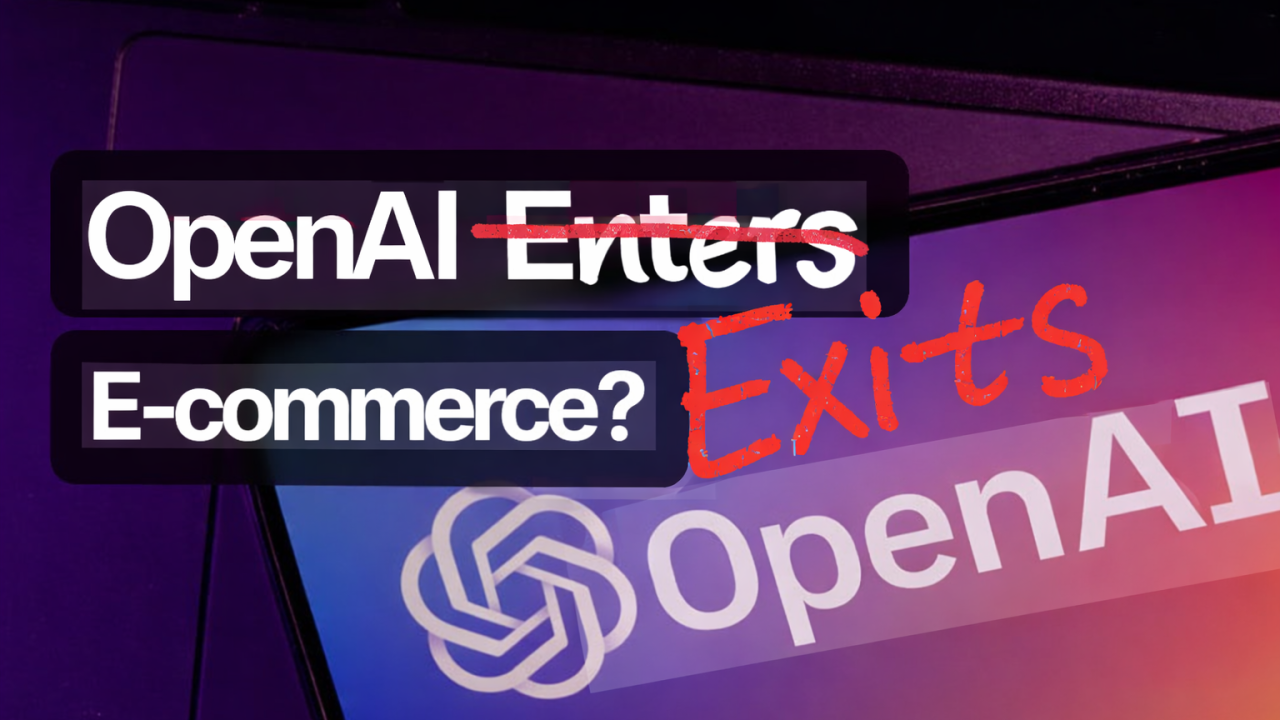
Five months ago, OpenAI pitched a bold vision for commerce inside ChatGPT: product discovery, recommendation, and purchase all happening in one conversational flow. In its September 2025 launch, OpenAI said shoppers could go from "chat to checkout in just a few taps," complete purchases "without ever leaving the chat," and let merchants keep control of payments, fulfillment, and customer relationships.
Now, that vision appears to be changing.
According to reporting published March 5, OpenAI is shifting away from direct checkout inside ChatGPT and instead prioritizing search, discovery, and routing users to merchant apps or sites to complete the transaction. Skift, citing The Information and an OpenAI spokesperson, reported that OpenAI is now "prioritizing making ChatGPT search and product discovery great," while moving Instant Checkout into apps rather than making it the default end state of the shopping journey.
That is not a small product tweak. It is a strategic reset.
The original Instant Checkout pitch was ambitious. OpenAI’s own launch materials described ChatGPT as an AI shopping assistant that could recommend products, surface organic results, and then pass order, payment, and shipping details to merchants through the Agentic Commerce Protocol. The help center still says Instant
Checkout is available in the U.S. for Pro, Plus, and logged-in Free users on eligible Etsy items and select Shopify merchants such as Glossier, SKIMS, and Spanx. In other words, the infrastructure exists — but the direction of travel now seems to be toward referral and merchant-owned conversion, not native platform capture.
Why does that matter?
Because this shift reveals something important about the economics of AI commerce: discovering intent is easier than owning the transaction.
Helping a user figure out what to buy is a natural fit for conversational AI. It is high-frequency, information-heavy, and benefits from synthesis. But actually closing the purchase is harder. Checkout is where edge cases pile up: taxes, refunds, fraud, inventory changes, fulfillment exceptions, identity verification, payment failures, returns, customer support, and regulatory complexity. OpenAI’s original model tried to abstract that complexity away while leaving merchants as the merchant of record. On paper, that sounds elegant. In practice, it puts enormous pressure on product reliability and partner integration. OpenAI’s own documentation makes clear that merchants still handle orders, payments, shipping, returns, and customer service — which means “instant” checkout was never truly a closed-loop OpenAI transaction in the first place.
That is why this retreat makes strategic sense, even if it looks awkward.
Sending traffic to merchants’ own sites and apps is less disruptive, less operationally risky, and probably more scalable. It lets OpenAI keep the high-value layer — intent capture, recommendation, and shopping orchestration — without taking on as much checkout friction. It also aligns more closely with how much of the internet already works: discovery happens in one place, conversion happens in another.
For merchants, that may actually be the more attractive model.
A lot of brands want AI-driven demand, but they do not necessarily want to surrender the last mile of the customer relationship. The merchant website is still where brands control merchandising, bundles, upsells, loyalty, attribution, service policies, and post-purchase experience. OpenAI’s September launch explicitly promised merchants “full control of their payments, systems, and customer relationships.”
Routing users back to merchant-owned destinations reinforces that promise more cleanly than trying to recreate commerce natively inside ChatGPT.
For the broader market, the reaction was telling. Travel and delivery-related stocks rose on the news, suggesting investors had been pricing in a more aggressive OpenAI move into transaction capture. Skift described the pullback as good news for online travel agencies, because fears of AI-driven disintermediation suddenly looked less immediate.
And there is a second story here, one that deserves attention.
This is another example of OpenAI moving fast on product ambition and then revising course in public. In September 2025, the company and NVIDIA announced a strategic partnership under which NVIDIA intended to invest up to $100 billion in OpenAI progressively as infrastructure was deployed. By late February 2026, Reuters reported NVIDIA was close to a much smaller $30 billion investment as part of OpenAI’s funding round. That does not make the original announcement false, but it does reinforce a pattern: OpenAI announces expansive visions early, then adapts quickly when operational reality sets in.
To be fair, this is what frontier companies do. They test boundaries. They overreach.
They learn. The issue is not that OpenAI changed its mind. The issue is what the change says about where durable value in AI commerce will actually live.
My view: the long-term winner is unlikely to be the company that owns every checkout screen. It will be the company that becomes the default layer for commercial intent — the starting point for what people want, why they want it, what trade-offs they care about, and which merchant is best positioned to fulfill that need.
In that world, merchant websites do not disappear. They become even more important.
AI may become the new doorway, but merchants still own the store.
Bottom line: OpenAI’s move away from instant in-chat checkout looks less like surrender and more like a recognition of where the real leverage is. Discovery is scalable. Trust is fragile. Checkout is messy. And for now, the smartest AI commerce strategy may be to influence the transaction without trying to contain it. This leaves the door wide open for Brands and merchants to build on AI discovery with their own AI powered experiences focusing on conversion and enhanced trust-on-site.